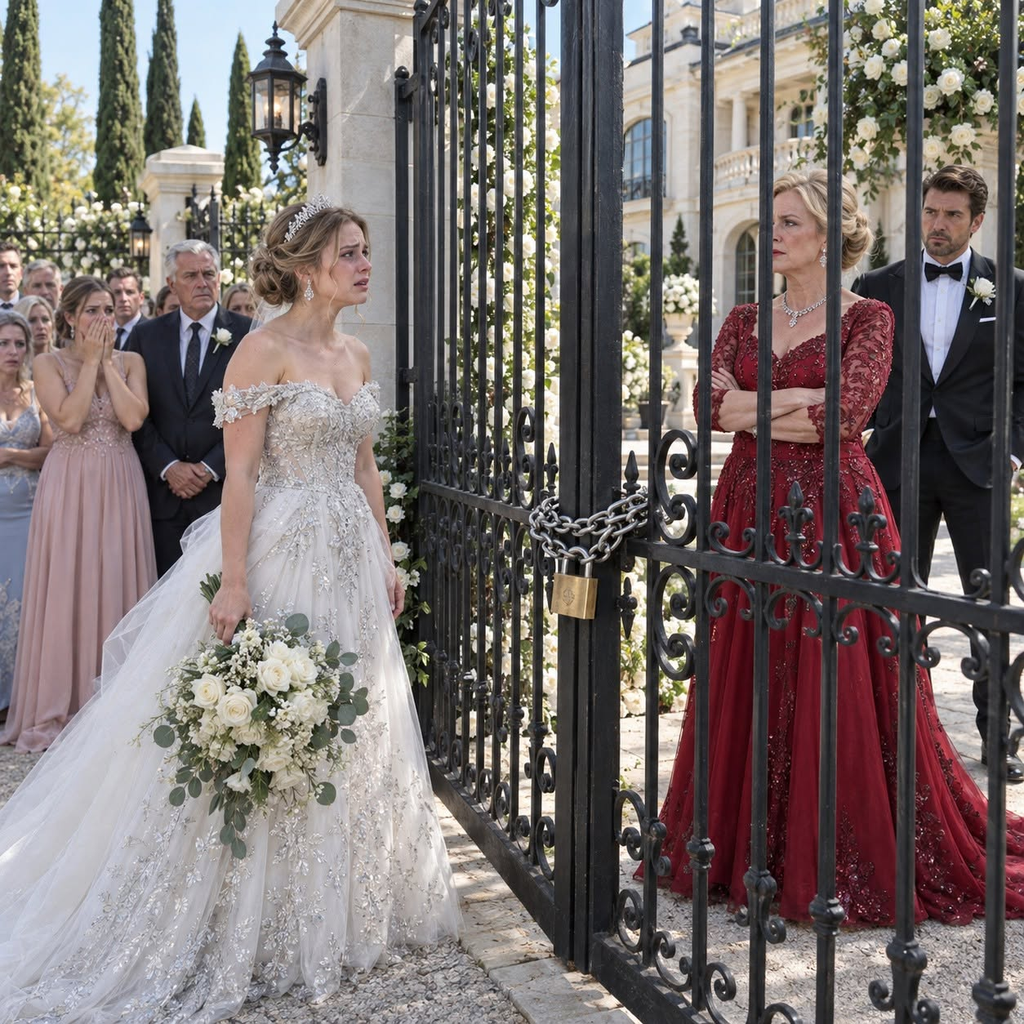
My husband lowered his eyes and quietly told me to obey her.
I didn’t argue. I simply took off my veil, canceled the wedding, and walked away.
The next morning, I came back with two moving trucks and a folder containing more than $85,000 in unpaid bills…
And the moment my mother-in-law saw what was inside that folder, she realized she had just made the biggest mistake of her life.
PART 1
“If you want to enter this family as my son’s wife, you’ll stand out on the curb for three hours. Let’s see if the cold air clears out your arrogance.”
That was the very first thing my future mother-in-law, Eleanor, said to me on my wedding day.
I was standing on the brick driveway outside Julian’s family home in suburban Illinois in my silk white wedding gown, holding a bouquet of fresh peonies, with nearly fifty of my family members parked in cars behind me. We had driven out from Chicago that morning expecting a celebratory backyard reception.
Instead, we found the wrought-iron driveway gates padlocked shut.
Eleanor stood on the other side of the gate wearing a sharp red dress, without a single trace of a smile.
“My psychic reader warned me this morning that Evelyn carries an overly dominant energy,” Eleanor announced loudly, ensuring the entire neighborhood heard every word. “If she steps onto this property like that, she’ll bring financial ruin to my son. She needs to wait outside for three hours to cleanse her spirit and learn humility.”
I honestly thought it was a joke.
My uncle, Arthur Vance, was the first to react, stepping out of his sedan. “Are you serious, Eleanor? Humiliating a young woman on her wedding day is what you call family tradition?!”
Eleanor crossed her arms smugly. “In my house, my rules are respected.”
I squeezed the stems of my bouquet until my knuckles turned white.
That house—that exact property—had been virtually rebuilt using my money.
I was twenty-nine years old, working as a senior financial director for an international logistics firm. Julian was an administrative clerk for a local municipality. During our engagement, he had constantly lamented how much his mother struggled and how their family home was falling apart.
Out of love, I made the foolish mistake of confusing generosity with an obligation.
Over eighteen months, I had personally financed a complete renovation: new roofing, hardwood floors, custom windows, remodeled bathrooms, a chef’s kitchen, fresh exterior paint, and custom cabinetry. I had also purchased a new refrigerator, washer, dryer, 65-inch smart TV, dining set, and a top-grain leather sectional that Eleanor had personally hand-picked.
I had invested over eighty thousand dollars of my own hard-earned money into that house.
And now I wasn’t even allowed through the gate.
I turned to Julian, desperately expecting him to shut his mother down.
Julian pulled me a few steps aside toward the sidewalk. “Evelyn, please… don’t make a big deal out of this.”
“A big deal?!” I gasped. “Julian, your mother locked the gate on our wedding day!”
“Just stand out here for a little bit,” he pleaded softly. “You know how she is.”
“And you’re going to let her do this to me? To my family?!”
Julian glanced nervously at the neighbors watching from their porches. “I work for the town government, Evelyn. I can’t afford a public scene right now. Besides, my mother’s blood pressure has been spiking. If she gets worked up and suffers a stroke, who’s going to carry that guilt?”
Then he uttered the sentence that finally ripped the blindfold off my eyes:
“A good wife needs to learn how to adapt to her husband’s family.”
He walked away. I watched him light a cigarette beside two of his groomsmen, casually chatting while the woman he claimed to love was being publicly paraded and humiliated in front of an entire street.
Arthur walked up beside me, laying a firm, comforting hand on my shoulder. “Evelyn, you don’t have to prove anything to these people. If you want to walk away right now, we walk.”
Julian trotted back over, frowning. “Evelyn, wipe that face off. You’re ruining our wedding.”
I looked at him for several long seconds, seeing him clearly for the very first time: a weak, cowardly boy forever tied to his mother’s apron strings.
I dropped my bouquet onto the pavement. I unclipped my veil.
Since I had worn a lightweight silk gown meant for a quick reception change underneath my formal train, I unlatched the heavy outer skirt, handed it to my bridesmaid, and put on Arthur’s trench coat.
Julian went dead pale. “What are you doing?!”
“What I should have done the second your mother locked that gate.”
I turned toward my family and called out clearly: “The wedding is canceled! Everyone back in the cars!”
Eleanor shrieked from behind the gate, while Julian tried to grab my wrist. I whipped my arm away, glaring at him with lethal coldness.
“I’m not leaving because your family is poor, Julian,” I said, my voice echoing across the driveway. “I’m leaving because you think humiliating a human being is ‘tradition’—and you’re weak enough to call it ‘patience.’”
Engines roared to life all down the street as my family turned their cars around. As I stepped into Arthur’s car, Julian slammed his fist against my window.
“You’re going to regret this, Evelyn! You’ll come crawling back!”
I looked at the newly renovated house one last time through the glass. He still didn’t understand. He thought he had just lost a bride. He had no idea that by locking that gate, his family had also just lost every single piece of furniture, appliance, and fixture inside that house that my money had bought.
And what I did the next morning was something none of them saw coming.
PART 2
At nine o’clock the following morning, I returned to Julian’s suburban neighborhood.
I wasn’t wearing a wedding dress. I was wearing jeans, boots, a black jacket, and carrying a thick leather binder packed with original purchase receipts, invoices, and bank statements. Driving right behind my car were two large commercial moving trucks and a crew of six hired movers.
Julian was watering the lawn when we pulled onto the driveway. A smug, arrogant smile spread across his face.
“I knew you’d come back to apologize,” he smirked, stepping forward.
I didn’t say a single word.
Eleanor appeared on the porch behind him, crossing her arms. “Before you step foot in my house, Evelyn, you’re going to kneel down on this porch and beg for my forgiveness!”
I turned to the moving crew leader. “Empty the house. Everything on the master inventory list.”
Six heavy-set movers pushed past Julian and marched straight through the unlocked front door.
Within ten minutes, the 65-inch smart TV came out first. Then the stainless-steel refrigerator. Then the front-load washer and dryer.
When two movers began unbolting the leather sectional, Eleanor came screaming out onto the lawn like a lunatic. “That’s mine! Stop them! That’s my furniture!”
I opened my binder, pulling out the first certified invoice. “Top-grain leather sectional. Purchaser: Evelyn Hartwell. Paid in full.”
I pulled out another. “65-inch television. Purchaser: Evelyn Hartwell.”
Another. “Smart refrigerator. Purchaser: Evelyn Hartwell.”
Julian frantically tried to close the front door because several neighbors had already walked out onto their lawns to watch.
I set up a folding table on the driveway, slapping down stack after stack of credit card statements, bank wire receipts, and product warranties. “I am not touching a single item that you or your mother purchased with your own money, Julian. I am taking what is legally mine.”
Eleanor grabbed hold of the washing machine as the movers carried it out. “It crossed my threshold! It belongs to my house now!”
“Then let’s call the local police department right now,” I replied calmly, pulling out my phone. “We’ll let the officers review my certified receipts against your bank records.”
Julian’s face drained of all color. He worked for the local town government—a police report for civil theft and fraud would ruin his municipal standing.
“Mom, let go of the washer!” Julian barked nervously.
“Julian!”
“Let it go!” he shouted.
For the first time, I saw genuine terror in his eyes. Not terror of losing me—terror of public exposure.
In less than two hours, the house was stripped almost entirely bare. But I wasn’t finished. I pulled out a second blue folder.
“The physical property I removed accounts for roughly thirty thousand dollars,” I said flatly. “Now let’s talk about the structural renovations.”
Julian stopped breathing.
I held up the certified contractor agreements: complete roofing, electrical overhaul, custom double-pane windows, hardwood flooring, brand-new bathrooms, and custom kitchen cabinetry. Total investment: over sixty thousand dollars.
“That capital was invested under the explicit agreement that I would be residing in this home as a married owner,” I stated, stepping toward Julian. “Since you and your mother intentionally breached our marriage agreement and barred me from the property, my lead attorney, Arthur Vance, has drafted a formal legal demand for full unjust enrichment restitution.”
Eleanor let out a hysterical, screeching laugh. “Then tear up the hardwood floors and rip out the walls, you crazy woman!”
“I don’t need to rip out the walls, Eleanor,” I smiled coldly. “I’m taking your family to court.”
I handed Julian the formal legal summons. “You have three business days to respond.”
PART 3
That evening, Julian’s sister, Chloe, showed up at my Chicago apartment carrying a basket of gourmet fruit and a sickeningly fake smile.
First, she offered a insincere apology. Then she cried. Then she claimed Eleanor had a fragile heart condition. Finally, she got straight to the point.
“Forgive the renovation debt, Evelyn,” Chloe pleaded. “We can pay you two hundred dollars a month.”
“That would take twenty-five years, Chloe. The answer is no.”
Her fake smile instantly vanished. Chloe slammed her hand against my kitchen island. “Then we’re going to tell everyone on social media that you abandoned Julian because his family is poor! We’ll tell the whole town that you humiliated an elderly woman and robbed her home!”
I walked over and opened my front door wide. “Do it.”
Chloe blinked, caught off guard. “What?”
“Do it,” I said, my voice dead even. “Just remember that I have high-definition video of your mother locking the gate, audio recordings of Julian telling me to stand in the cold, original bank transfers, and statements from fifty wedding guests who witnessed the entire scene. Please, post your story. My attorney is waiting.”
Chloe stormed out, furious.
Two days later, while I was at my corporate office in downtown Chicago, reception called my desk. “Evelyn… there’s an elderly woman in the main lobby. She’s causing a massive disturbance, claiming you defrauded her family.”
My stomach hardened into ice. I took the elevator down.
Eleanor was sitting right in the center of the polished marble lobby, weeping hysterically in front of security guards, corporate executives, and clients.
When she saw me step off the elevator, she pointed a shaking finger at me and screamed: “This woman tricked my son! She used us! She stripped my home bare!”
Dozens of corporate eyes turned toward me. Eleanor offered a subtle, triumphant smirk through her fake tears, believing she had finally backed me into a corner.
I pulled out my phone, switched on the video camera, and pulled out a backup folder from my briefcase.
“Eleanor,” I said loudly, my voice ringing clearly across the marble lobby. “Repeat on camera that the money used to renovate your home came from your bank account.”
The lobby went dead quiet.
She opened her mouth, but no words came out.
“Repeat it,” I demanded, stepping closer. “Tell these security officers that you paid for the hardwood floors, the custom kitchen, the roof, and the furniture.”
“I… my son…” she stammered.
I opened the folder, holding up the certified bank statements. “Every wire transfer originated from my personal corporate account. Here are the contractor receipts. And here are printed text messages from you thanking me for paying for your new kitchen and leather sectional.”
The crowd’s murmurs instantly shifted.
Eleanor panicked. “But you were supposed to join our family!”
“Exactly. Supposed to. Until you padlocked the driveway gates on my wedding day, demanded I stand in the cold for three hours to ‘cleanse my energy,’ and my fiancé stood by silently while I was humiliated.”
The head of corporate security stepped forward, looking at Eleanor with utter disgust. “Ma’am, you need to leave this building immediately. If you have a civil dispute, handle it through the courts. If you do not leave private property right now, you will be arrested for criminal trespass.”
Eleanor stood up slowly, her face red with embarrassment, and rushed out the glass doors, covering her face.
That night, my uncle Arthur Vance filed our formal civil lawsuit for financial fraud and unjust enrichment against Julian and Eleanor.
To avoid a public trial that would ruin Julian’s municipal career and expose Eleanor’s fraudulent behavior to the entire county, their family was forced to sell a parcel of inherited land outside the city. The proceeds were used to pay back every single dollar I had invested in their home.
As for the furniture I had hauled away on the moving trucks?
Julian called me weeks later, begging for the leather sectional back. “My mother chose that furniture, Evelyn! Have some humanity!”
“I paid for it, Julian,” I replied coldly.
I didn’t keep a single piece. I sold the high-end items, used part of the money to cover moving expenses, and donated the rest—along with brand-new appliances—to a local Chicago shelter for women rebuilding their lives after escaping abusive homes.
Six months later, my firm offered me a promotion to Regional Financial Director in Texas, doubling my salary. I accepted without hesitation.
I moved into a high-rise apartment overlooking the city, made wonderful new friends, traveled abroad, and built a life rooted entirely in self-respect.
Nearly a year later, my friend called me from Illinois, laughing over the phone. “You won’t believe what happened to Julian.”
“What did he do now?”
“His mother is still trying to find him a wife,” she laughed. “But word spread around the county about the ‘gate incident.’ Every time Julian tries to date someone local, their family asks: ‘Wait, isn’t that the family that locked their bride out on the curb?’ The last girl broke up with him after he told her his mother always has the final say in his house.”
I didn’t laugh. I just felt a quiet, profound sense of peace.
Julian had been given every opportunity to be a man. On our wedding day, he could have unlocked that gate. He could have stood up to his mother. He could have chosen dignity over cowardice.
He chose silence.
Sometimes, your life doesn’t change because of a massive tragedy. It changes because, in one small, pivotal moment, you finally realize what you are worth—and you refuse to ever let anyone make you shrink again.