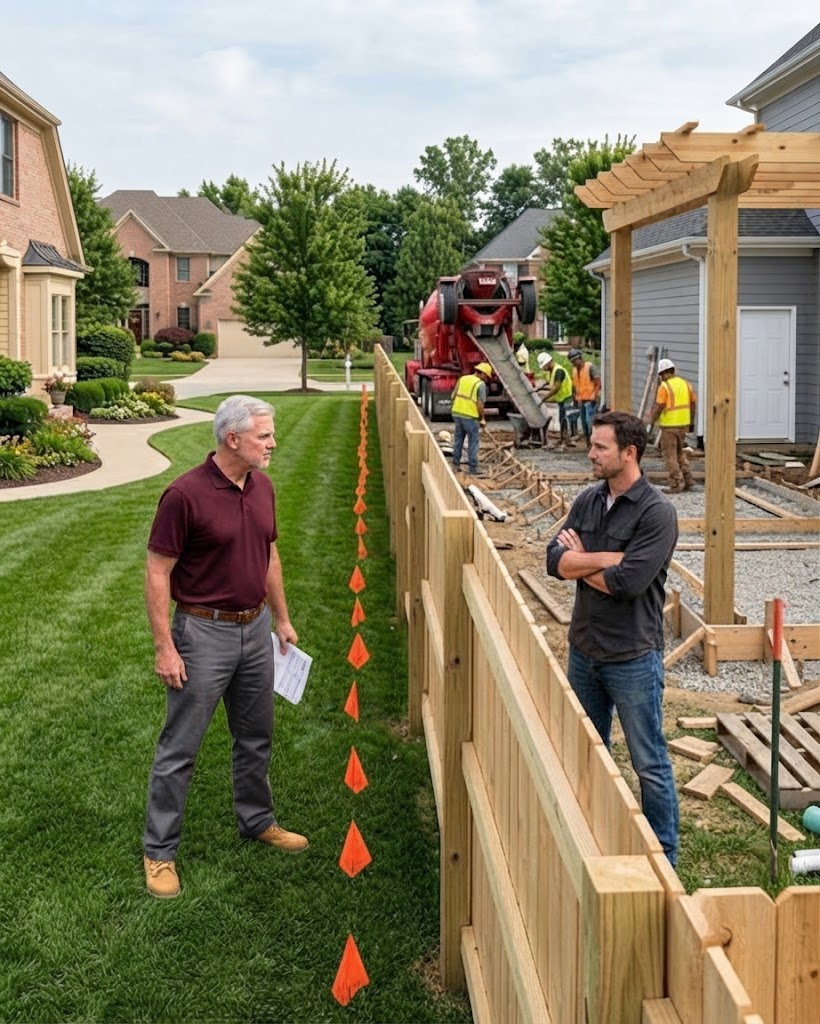
The first cedar post of the new fence sat exactly eight feet inside my property line, its raw, yellow-white wood looking like a stake driven into the lawn.
Through the open window, the sharp, sweet smell of fresh-cut wood drifted over the stove where I was frying eggs.
Emma dropped a heavy textbook into her blue duffel bag on the kitchen table.
“Mom, why are those men digging holes in our grass?”
I turned the heat down on the burner and adjusted my glasses, pushing them up the bridge of my nose.
“They must be starting Tyler’s fence.
He mentioned he wanted some privacy back there.”
“Privacy on our side of the lilac bushes?” Emma twisted her silver ring around her finger, her brow furrowing as she leaned against the counter.
“That doesn’t look right at all.”
“I am sure it is just a misunderstanding,” I said, though my chest felt tight.
“Tyler is a commercial real estate agent, so he knows how these things work.”
“He knows how to take whatever he wants,” Emma said, zipping her bag with a sharp yank.
“You need to go out there before they dig any more holes.”
I looked at the three workers in the yard, their shovels biting into the turf I had mowed myself for eleven years.
The main question was whether a professional surveyor would confirm my memory of where my land actually ended, or if I had been mistaken all this time.
That afternoon, the lawn was dry enough for the first cut of the week.
I pulled the starter cord on my green mower and guided it along the familiar path near the edge of the property.
The engine roared, but I had to cut the throttle and pull the machine to a halt eight feet short of my usual turning spot.
The newly completed cedar fence, solid and smelling of fresh sap, blocked my path like a wall.
I stood there behind the vibrating mower, looking at the pristine cedar boards that stretched from the back corner of Tyler’s house all the way to the edge of my garden shed.
A fence like this, custom-built and sturdy, easily cost eighty-two hundred dollars.
My mind kept returning to the cost of a proper county survey, which my friend at the library told me would run about nine hundred and fifty dollars.
If I paid that money, would the surveyor find that the new fence was actually sitting on my property?
The silence after I shut off the mower engine was heavy, broken only by the sound of a car door shutting next door.
Tyler was home.
He was lifting two plastic grocery bags out of the back of his clean SUV when I walked over to the edge of his asphalt driveway.
“Hi, Tyler,” I said, keeping my voice level and slow.
“I wanted to talk to you about the new fence.
It seems to have come quite a bit over onto my lawn.”
Tyler did not look up immediately; he adjusted his grip on the bags and jingled the loose change in his pocket, a fast, metallic rhythm.
“Joan, great to see you.
The fence is top-notch, isn’t it?
Cedar, seventy-two inches, absolute peak curb appeal.
It really elevates the whole block’s valuation.”
“It is very nice,” I said, adjusting my glasses again.
“But it appears to be eight feet past our actual boundary line.”
“The contractors used the county plat map and their own digital layout,” he said, speaking in a rapid-fire clip that left no room for pause.
“They are licensed professionals, Joan.
They don’t make mistakes like that.
It is all about maximizing the footprint.”
“I have lived here eleven years, Tyler, and my lawn has always gone all the way to the old telephone pole.”
“The old markers are usually wrong anyway,” he said, taking a step toward his side door.
“Trust the digital plots.
They are accurate to the inch.”
“I might have to call a county surveyor to verify,” I said.
Tyler stopped, his fingers tightening on the grocery bags.
“Fences end up a little off all the time, Joan.”
He turned his back and walked inside his house, the change in his pocket jingling with every step.
In the living room after dinner, the evening light was fading, casting long shadows across the carpet.
Emma had cleared the kitchen table and sat on the sofa with our old leather-bound photo albums spread open.
“Look at this one from my seventh birthday,” Emma said, pointing to a glossy print of her in a bright yellow sundress.
“You can see the garden shed and the old oak tree.”
I sat beside her and took the photograph, holding it close to the lamp to study the background.
In the frame, the old wooden swing hung from a thick branch of the oak tree, its thick hemp ropes worn gray by the weather.
“That swing has been there since Emma was six years old,” I said softly, my finger tracing the edge of the wooden seat in the photo.
“It’s still there,” Emma said, her voice dropping as she looked toward the backyard window.
“But you can’t get to it now.”
I stood up and walked to the sliding glass door, looking out into the dim yard.
The thick oak branch reached out over the new lawn boundary, and the wooden swing hung motionless, trapped on the wrong side of the high cedar boards.
Carl Henderson did not look at the wooden swing trapped behind the new cedar fence.
He dragged a heavy yellow metal locator through the tall clover near my garden bed, the machine giving off a low, rhythmic hum that ticked like an old kitchen clock.
I watched him from the edge of my patio, holding my coffee cup with both hands to keep them steady.
“There should be an iron pin right about here,” Carl said.
His voice was a low, gravelly drawl that sounded like stones sliding down a wooden chute.
He stopped, wiped his forehead with a faded blue handkerchief, and stuffed it back into his rear pocket.
“The county records show the original parcel was split in nineteen seventy-four,” I said, adjusting my glasses on my nose.
Carl did not answer right away.
He turned a black dial on his machine and swept the plastic disk back and forth over a patch of wet dandelions.
He shook his head, his brow furrowing as he looked at the display.
“These new digital maps the county uses are always half a yard off,” Carl muttered.
“They rely on satellites instead of getting their boots dirty in the grass.
You cannot find a true corner from space.”
he steady hum spiked into a sharp, high-pitched squeal that made me step back.
“Found it,” Carl said.
He knelt in the damp grass, pulled a small hand trowel from his canvas bag, and began to scrape away the thick sod.
I stood close to his shoulder, watching his calloused fingers dig into the dark Ohio clay until they scraped against something hard and rusted.
It was the top of an old iron pipe, no wider than a quarter, buried three inches deep.
“Is that the actual corner of my property?” I asked.
Carl pulled a heavy steel tape measure from his belt and hooked its brass end to the rusted pipe.
“This is the southeast corner pin,” he said.
He walked toward the new cedar fence, letting the steel tape hiss out of its metal case.
“Now we see where eighty-two feet puts us.”
He stopped well before he reached the cedar boards.
The yellow tape measure stretched tight between his hands, hovering six inches above the green grass.
Carl looked down at the numbers on the tape, then looked up at the heavy cedar posts Tyler Bennett had set into the ground.
“The fence is eight feet inside your line,” Carl said.
My stomach tightened.
“Eight feet?”
“Eight feet and four inches, to be exact,” Carl said.
He made a pencil mark on a yellow notepad.
“But I need to run the line from the front pin near the road before I can sign off on a certified survey.”
“How long does that take?” I asked.
“I will have the official drawings ready by Thursday afternoon,” Carl said, hooking the tape measure back onto his leather belt.
“I have to verify the road easement first.”
“Thank you, Carl,” I said.
He picked up his metal locator and walked toward his truck, his work boots sinking slightly into the soft earth.
I stayed by the rusted pin, looking at the distance between the iron pipe and the raw, sweet-smelling cedar wood.
Emma was sitting at the kitchen table when I walked inside, a cardboard box of college textbooks resting on the chair beside her.
She was twisting her silver ring around her thumb, her eyes fixed on the white paper tax assessor map I had spread across the Formica.
“If the pin is there, then Tyler built the whole thing on our grass,” Emma said.
“Eight feet of it,” I said.
I pointed to the county map, where our house was drawn as a neat rectangle with a dotted line marking the property boundary.
Beside the drawing, I had written Carl’s preliminary measurement of eighty-two feet in blue ink.
“He must have known,” Emma said, her voice rising with that quick energy she got when she was anxious about leaving home.
“You don’t just accidentally miscount by eight feet, Mom.”
“He had a contractor do it,” I said, trying to keep my voice even.
“It was probably just an honest mistake.”
“A mistake that takes away our swing?” Emma asked.
She stood up and walked to the kitchen window, looking out at the bright cedar wood that blocked our view of the old oak tree.
“We need to tell him today,” Emma said.
“I want to speak with a lawyer first,” I said.
“Just to make sure I understand the deed.”
Emma turned back to the table, her finger tracing the edge of the cardboard box.
“A lawyer is going to cost money we don’t have, Mom,” she said.
“Nine hundred and fifty dollars for the survey is already gone,” I said, folding the paper map into a neat square.
“But we cannot leave this alone.”
“What if he won’t move it?” Emma asked.
“We will see what the lawyer says,” I said, placing the folded map into my purse.
“You have to stand up to him,” Emma said, her voice dropping.
“He is just going to keep pushing if you don’t.”
“I am going to handle it,” I said, though my hands were cold.
The office of Monroe and Associates sat between a pediatric dentist and a dry cleaner in the brick strip mall on State Route Three.
Inside, the air smelled of old paper and carpet cleaner.
Rachel Monroe took the folded tax assessor map from my hand and laid it next to a copy of my property deed.
She was forty-eight, with sharp grey eyes and a navy blazer that looked freshly pressed.
“Your deed is very clear, Mrs.
Miller,” Rachel said.
She tapped her silver pen on her notepad with a steady, rhythmic click.
“The boundary line runs straight from the iron pin at the road to the pin Carl found in your backyard.”
“So the fence is definitely on my property?” I asked.
“Based on these preliminary numbers, yes,” Rachel said.
“But a preliminary measurement is not a legal document.
We need Carl’s certified survey before we can take any formal action.”
I adjusted my glasses on my nose, my throat suddenly dry.
“What kind of action?”
“A formal letter demanding they remove the encroachment,” Rachel said.
She stopped tapping her pen and wrote a quick note on her pad.
“If he refuses, we file for an injunction in county court.”
“I don’t want to go to court,” I said.
“Tyler seems like a reasonable young man.
He just bought the place.”
Rachel sighed, looking out the window of her office toward the parking lot.
“Our local zoning officials are incredibly slow to respond to these kinds of permit violations,” she said, her voice carrying a quiet edge of frustration.
“If we wait for the county to act, the fence will be the least of your worries.”
“What do you mean?” I asked.
“People can surprise you when eighty-two hundred dollars of cedar fencing is on the line,” Rachel said.
She slid the deed back across the desk toward me.
“Talk to him tonight,” Rachel said.
“But do not sign anything he gives you, and do not make any deals without me looking at them first.”
“I just want to show him the numbers,” I said.
“Just remember,” Rachel said, leaning forward.
“The law does not protect people who sit on their rights.”
“I understand,” I said.
“Call me as soon as Carl delivers the certified survey,” Rachel said, her silver pen hovering over her pad.
Tyler’s silver SUV was idling in his gravel driveway when I walked over, the headlights throwing long yellow beams across the lawn.
He was lifting a blue plastic cooler from the back seat, his movements quick and efficient.
“Tyler,” I said, stopping at the edge of the asphalt.
“Joan, hey,” he said, shutting the car door with his elbow.
He wore a golf shirt with a small logo on the chest, and his pockets jangled with the sound of loose coins.
“Fabulous evening, isn’t it?
I was just getting some things ready for the weekend.”
“I wanted to talk to you about the fence,” I said, holding out the yellow notepad where I had written Carl’s measurements.
“The surveyor was out this morning.”
Tyler did not look at the notepad.
He leaned against the side of his SUV and smiled, his teeth very white in the twilight.
“Oh, the surveyor,” Tyler said, his words coming in a rapid-fire rush.
“Great guys, very thorough.
But you know how those old county maps are, Joan.
They use technology from the dark ages.
It is all about modern parcel optimization these days.”
“He found the original iron pin,” I said, my voice sounding small even to me.
“The fence is eight feet onto my side.”
Tyler let out a short, easy laugh that did not reach his eyes.
“Fences end up a little off all the time, Joan,” he said.
He reached into his pocket, his hand moving as he jangled his loose coins.
“It is a standard margin of error in residential developments.
We are talking about a few inches of grass.”
“It is eight feet,” I said.
“And it blocks the wooden swing.”….