I couldn’t do it alone.
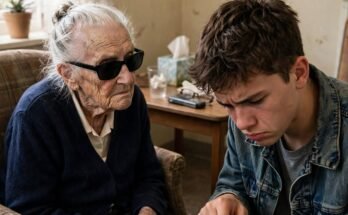
I called Ed from the parking lot. I said, “You need to come home.” He didn’t ask me why. It’s three hours from Dayton, and he made it in two and a half. He stood in the door of Sam’s room with his hat in his hand, and he looked so old.
Andre had come too. I had made him. He sat on the edge of the bed where I pointed, as if it might break.
I took the backpack down from the door. It was blue, with a broken zipper pull that Sam had fixed with a paper clip. It smelled like him, or I told myself it did.
I unzipped it.
There was a math worksheet with a star on it. There was a rock. There were two pencils chewed down to nothing, and a wad of wax paper, flattened and folded very small.
At the bottom was a green spiral notebook, the kind you buy for a dollar. I opened it on my knees. On the first page, in his big, leaning, ten-year-old handwriting, in pencil, it said:
STUFF TO DO WHEN I GET BETTER
- Tell Mom why I was hungry. She thinks I was being bad.
- Give Andre my coat. Its too small for me anyway and he doesnt have one.
- Ask Mom and Dad if Andre and his mom can have the guest room. We dont use it.
- Learn a backflip.
Ed made a sound I had never heard a person make. He came across the room and sat on the floor by my feet, a 66-year-old man, and he put his forehead on my knee.
I turned the page.
There was one more. The handwriting was worse. He must have done it in the hospital, on one of the bad days, when I had gone down the hall for coffee. I didn’t know that he knew. We had all been so careful. We had told him he was going to be fine.
IF I DONT GET BETTER
Mom you have to make 2 sandwiches now.
He likes the big half.
Dont tell him you know.
I don’t know how long we sat there, the three of us. I know that it got dark. I know that at some point Andre got up and turned on the lamp, and that he went to the kitchen. I heard him open the bread box, and I heard a knife. He came back with a plate and set it on Sam’s desk, and it was peanut butter on white, and he had cut it down the middle, perfectly straight.
He frowned at it, and then at me.
“I can’t do it like you,” he said. “I’ve been trying for fourteen years. I have to go at it twice to get it wrong.”
I laughed. I hadn’t laughed in that room since 2012. It came up out of me like something being pulled from the ground, and then I was crying again, and Ed had his arm around my legs, and I didn’t mind any of it.
Andre told me the rest over the next few weeks. He and his mother got a place in Akron that summer, and she found work in a school cafeteria. She drove him to the cemetery every Friday before her shift, forty minutes each way, until he turned sixteen and could drive himself. Neither of them ever missed. He worked his way through a culinary program. He delivers for a bakery now, and he’s saving for a food truck. All those years, he had come with a sandwich he had practiced ruining.
I gave him Sam’s coat. It doesn’t come close to fitting him. He has it hanging in his van.
Ed moved home in August. We don’t talk about whether that’s permanent. He cuts the crusts off things now, for reasons of his own.
And in September, I went down to Lincoln Elementary with a cooler, and I had a talk with the principal.
There’s a table outside the library now, every school day. Anyone can take a sandwich from it, and there is no form, and nobody writes anything down. There’s just a hand-lettered sign, which a boy in third grade made for us, and it says: THESE WERE CUT WRONG. PLEASE TAKE ONE.
We make four hundred a week now. Andre runs the kitchen. Half the church helps. New volunteers always try to cut them straight, and I have to take the knife away and show them.
Andre got married in the spring. They had a baby boy in October. I won’t tell you what they named him, because you already know.
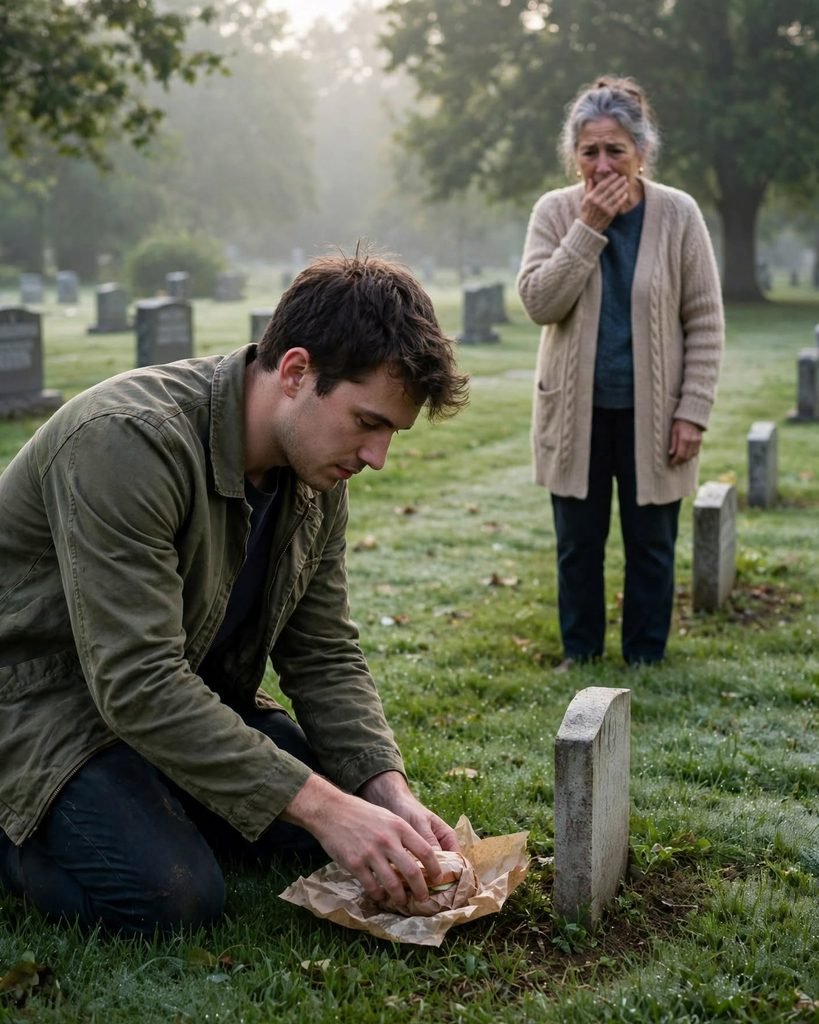
I still go to the cemetery. I go on Fridays now.
Some weeks, I beat Andre there. I get out of the car in the gray light with my wax paper, and my knees complaining, and I kneel down and tell my son about my week. I tell him I know why he was hungry. I tell him I’m sorry about the kitchen. I tell him that he was never being bad, not one day of his life.
He told me not to tell Andre I know, and I’d like it on the record that I tried.
Then I unwrap it and set it on the ledge. One half for him, and one half for me. I sit there and eat with my son while the sun comes up.
I give him the big half.
This is a work of fiction. All names, people and events are invented.