He drove straight through from Camp Lejeune, twenty-two hours. He was retired by then, a square man gone gray, with a bad hip. He sat at my kitchen table on Monday morning, the same table I had thrown him out of, and he held a cup of coffee and didn’t drink it.
“I tried to tell you once,” he said. “You weren’t ready, and I didn’t blame you. Can I tell you now?”
I said yes. I sent Micah to the other room. He stood in the hall and listened anyway. I knew he was there.
“It was a road outside Sangin,” Gunny said. “Rook alerted. He sat down hard, the way they do. He’d never been wrong. Luke got the squad stopped. He got everybody back, nine guys, walking backward in their own bootprints. Then he went up for his dog, because you don’t leave your dog. And there was a second one nobody could’ve seen.”
He looked into the coffee.
“When we got to them, Rook had shrapnel all down his ribs and half his ear gone. And he was lying across Luke’s chest. Across him. He wouldn’t move. The corpsman went to reach for Luke, and that dog about took his arm off. He wasn’t being mean. He was on duty. He thought he was protecting him. He would not let any of us come near. We had maybe two minutes, and nobody could get close, and somebody was talking about shooting him.”
He stopped for a while.
“So I got down in the dirt,” he said. “And I sang that stupid song. I’d heard Luke do it a hundred times through the kennel wall. I can’t sing either. I got to the end, and I whistled. And that dog looked up at me, and he got off of him. He crawled. He crawled off, with his ribs hanging out, and he let us in.”
I was holding on to the edge of the table.
“It didn’t matter,” Gunny said, very gently. “I need you to know that. It wouldn’t have mattered if we’d had two hours. The doc told me. But the last thing your husband heard was somebody singing that song, ma’am, and he was smiling. I don’t know why. I think he thought I sounded terrible.”
Behind me in the hall, there was a small sound. I turned around. Micah was standing there with tears running down his face, the first ones I had seen in five years.
“Did Rook get better?” he said.
Gunny turned in his chair and took a long look at my son. I think he was seeing Luke.
“They patched him up,” he said. “He never worked again. He wouldn’t let anybody touch his neck. That’s how you’d carry a hurt dog, by the collar, so when somebody reaches for it, he’s back on that road. They retired him to a handler in Texas, an old guy I knew. The old guy passed away this summer, and his kids didn’t know what they had. They let him out on the highway, or he got out. I’ve been calling every shelter in three counties for two months, looking for a dog named Rook. Nobody had one.”
“They were calling him Tank,” I said.
Gunny closed his eyes.
“He bit three people by the collar,” he said. “That’s all he did. Let’s go see this lady.”
We were at the shelter when it opened on Friday. He had made some calls. So had I. There was a colonel’s letter in his jacket, and the Marine Corps League had agreed to cover the injured man’s bills, every cent. When he heard whose dog it was, the man with the bad thumb said he’d be withdrawing his complaint.
Mrs. Dietz read all of it at her desk. She took off her reading glasses.
“It’s a good letter,” she said. “But a letter doesn’t tell me about your boy’s safety. I’ve seen what that dog can do. I’m not going to sign this because it’s a nice story. I’m going to see it.”
So we went down the last row. There was no one there but the five of us. Gunny Alvarez took a stool from the corner and set it outside the gate, and he said to Micah, “All right, Marine. Go on in.”
“Absolutely not,” said Mrs. Dietz.
“Ma’am, you asked to see it,” Gunny said. “I’ll be right here. I’ve got him.” Then he looked at me.
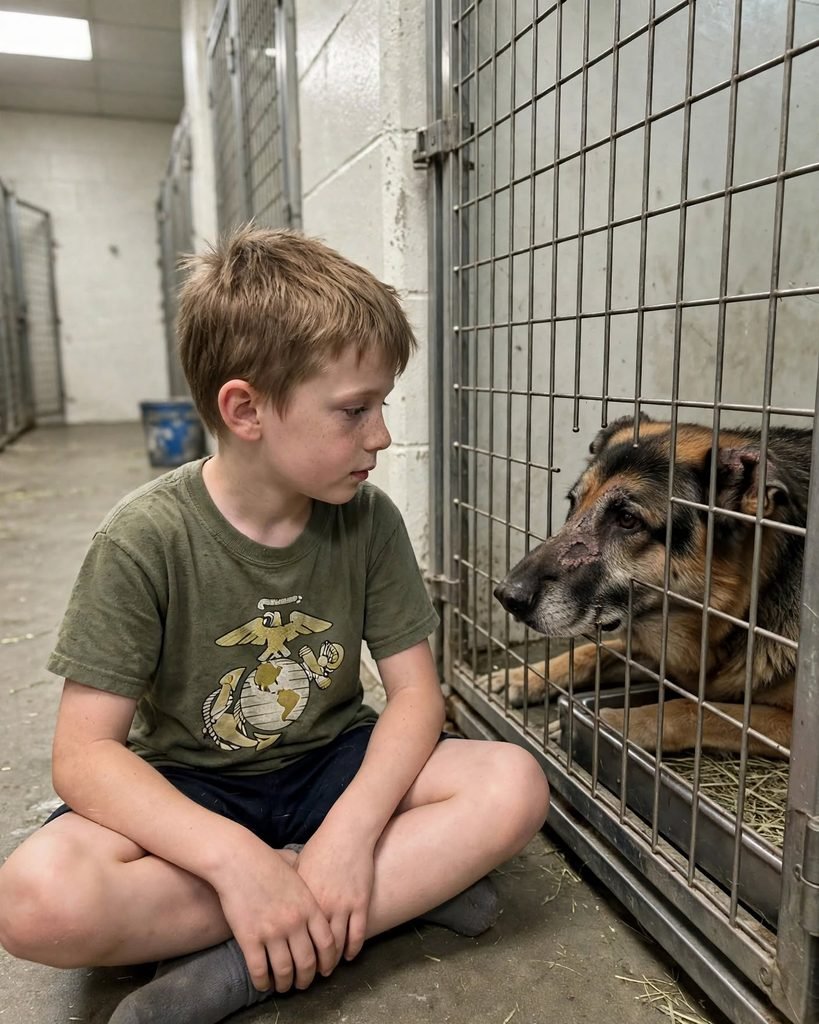
I have never done anything harder. I looked at my son, in his Marine Corps T-shirt that hung to his knees. I looked at that animal in the corner, with all his scars.
I nodded.
Hannah opened the gate. Micah walked in, and sat down on the concrete, and the dog came out of the corner on his stiff old legs. He smelled Micah’s hair. He smelled his neck and his hands. He took a long time. Then he walked around behind my son, and I stopped breathing. He lay down across the back of Micah’s legs, facing out, with his gray head up and his eyes on the gate, and he looked at every one of us, one at a time.
Nobody said anything.
“He’s posted,” said Gunny Alvarez. His voice wasn’t working very well. “That’s a dog on post. Ma’am, you want to try to get to that boy now? I wouldn’t.”
Micah reached around behind him without looking. He slid his small hand under the old leather collar, right at the neck. The dog sighed.
Mrs. Dietz stood there for some time. Then she put her glasses back on, and she took the red card off the gate. She tore it in half.
“He’ll need his shots,” she said.
That was two years ago. Rook is twelve now, and his hips are bad, and he sleeps most of the day in the sun on our back step. He hates the mailman. He hates the vacuum. He tolerates me.
Micah is eleven. He eats lunch with a boy named Oscar. He talks about his dad now, all the time, at dinner, and he has started asking Gunny Alvarez questions on the phone on Sunday nights. He turned his hall light off last winter. He said he didn’t need it.
Every night at nine, that old dog hauls himself up the stairs, one at a time. It takes him a while. He doesn’t sleep on Micah’s bed, though Micah has asked him to. He lies down across the bedroom doorway, facing out, with his one good ear up.
I stop there sometimes on my way to bed. I can hear my son through the door, singing, in a voice that’s starting to crack.
He can’t sing either. He gets to the end of the verse, and he whistles those three terrible notes.
And in the dark, that ear goes up.
My husband said he was going to bring that dog home.
It took him five years, but he did it. And that dog is still on duty.
This is a work of fiction. All names, people and events are invented.