She told me to be at the old bus garage at nine o’clock on Saturday. She told me to wear my jacket.
I didn’t want to go. Dot made me. She was thin as a coat hanger by then, but she got up that morning, put on lipstick, and sat in the truck with her purse on her lap.
It had snowed in the night. We came down Route 9 slowly, past the closed-up company stores and the church with the sagging porch, and about a mile from the garage, I saw the first car parked on the shoulder.
Then I saw another one, and then a whole line of them, both sides of the road, with plates from Ohio and Maryland and Texas. People were walking along the shoulder in the snow. A state trooper in a brown hat stood waving traffic through. When he saw my truck, he took off the hat and held it against his chest.
“Earl,” said Dot. “Keep your eyes on the road.”
I couldn’t see the road very well.
There must have been eight hundred people in that lot. Men with gray in their beards. Nurses still in scrubs. A big fellow in a Steelers jacket with three kids on him. They stood in the snow and went quiet when I pulled in. Nobody cheered. It was the quietest eight hundred people I ever heard.
And every one of them was holding a coat.
Children’s coats, in every color. Little boots. Mittens on a string. They had pulled them out of attics and cedar chests. Some of them had kept their coats forty years and couldn’t have told you why.
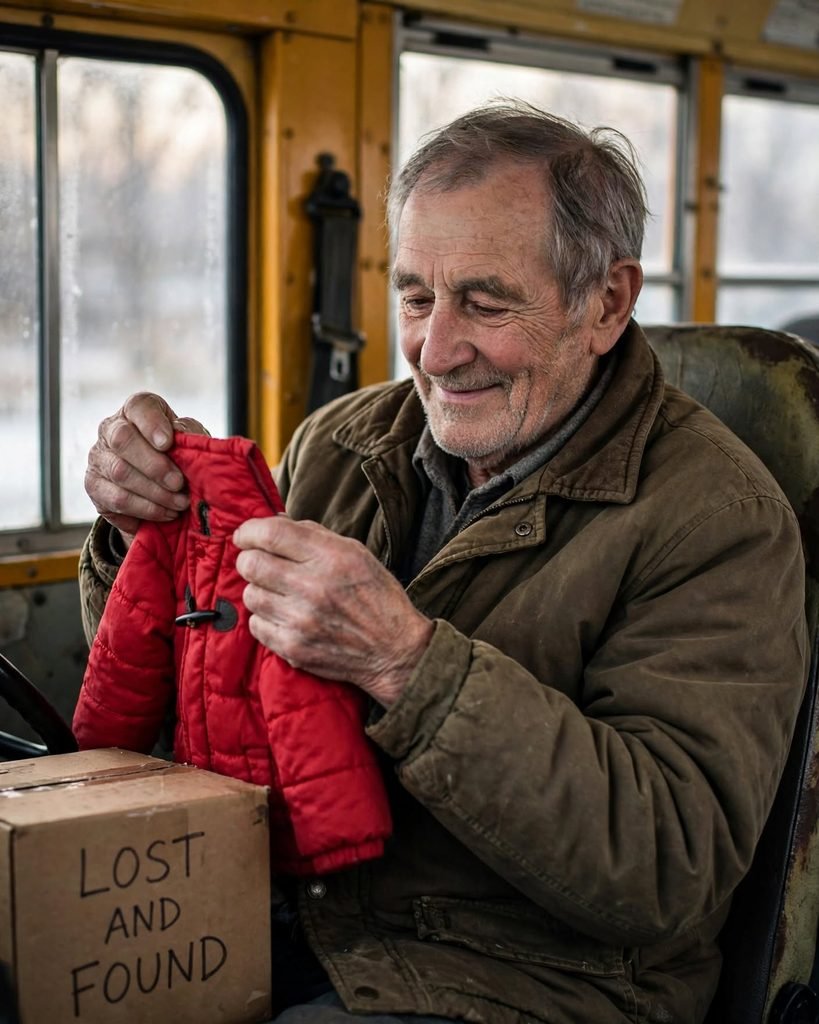
In the middle of the lot sat my old bus, Number 14. Somebody had bought it at auction. On the front seat was a big cardboard box, and on the box in fresh marker, in somebody’s very careful imitation of my terrible handwriting, it said: LOST AND FOUND.
Renee helped me up the steps. I looked in the box.
It was full of envelopes.
“Those are from all of us,” she said. “We paid off the mortgage on Thursday. The hospital took a settlement on Friday, and I may have been unpleasant about it. Your pension shortfall has been made up in full. Nobody signed their names. So you can’t thank anybody.”
She had that little smile on her, the one she’d had when she was six and thought I didn’t see.
“Somebody must have lost it,” she said. “You’d be doing us a favor.”
I’m not ashamed to tell you I sat down on the top step of that bus and cried like a child, in front of God and the Pennsylvania State Police.
One by one, they came up. Nobody made a speech. A man who ran a hospital told me I’d given him boots in 1994. A woman told me the note was the only reason she’d stayed in school. A young mother I barely remembered took off her glove and shook my hand. She pressed a little square of paper into it, closed my fingers around it, and walked away without saying a word.
Then a thin man in a nice suit came up and stood in front of me. It took me a moment.
“Mr. Tibbets,” said Superintendent Vance.
He was retired by then. He looked old. He was holding a brown corduroy coat with a torn pocket, a boy’s size eight.
“It wasn’t your bus,” he said. “It was a long time ago, in another county, and it was a driver named Fisk, and he gave me this and told me he found it. I’ve spent forty years pretending I didn’t remember what cold felt like. I read that post, and I drove up here.” His jaw was working. “I wrote you up for the best thing I ever saw anyone do.”
I looked at that coat, and then at him. I’ve had a lot of years to be angry, and I found I didn’t have time for it.
I reached over and patted the seat beside me.
“You look cold,” I said.
He sat down.
Dot lived fourteen more months, in her own house, with her own garden, and with more casseroles than two hundred people could eat. She knit until the last week. She went in her own bed, with her hand on my neck.
I’m seventy-three now. They asked me if I wanted my job back, and I told them my knees wouldn’t take it. But there’s a young woman driving Route 9 now, and she’s one of ours. She came to see me last fall with a cardboard box and asked what I thought.
There’s a fund for it now. It’s enough to do every school bus in four counties.
We still don’t give anything away. Nobody asks, and nobody has to say thank you. Somebody just lost it.
I sit at the kitchen table on winter nights with a stack of little papers and a ballpoint pen. My handwriting has not improved.
Renee came by last week with her youngest daughter, a little thing about six. The child stood in my kitchen in a thin jacket, eyeing the mittens on the table.
“Those are nice,” she said. “Whose are they?”
I looked at Renee. Renee looked out the window.
“Well, I don’t rightly know, kiddo,” I said. “Somebody lost them. It’d sure be a shame.”
This is a work of fiction. All names, people and events are invented.